


Cooler air, warm soil, and reliable moisture create good conditions for seed germination for cool-season grasses like fescue, bluegrass, and ryegrass. Overseed in fall and your new grass gets several months to grow strong roots before winter dormancy. Those roots come back stronger in spring.
Whether you're filling in a few thin patches or giving a tired lawn a full renovation, timing and technique matter more than anything else. This guide covers regional timing, the full overseeding process, bare spot repair, seed selection, and a 30-day post-seeding calendar, with the specific numbers you need.
One note before we dig in: a thick lawn is the most effective prevention against weeds. Smart watering, feeding and mowing do most of the work. Use chemical control only as a last resort.
When to overseed: seasonal timing by region
Successful overseeding comes down to matching your seeding window to soil temperature. Grass seed germinates best when the soil is consistently warm enough to support root growth but the air is cool enough to be gentle on tender seedlings.
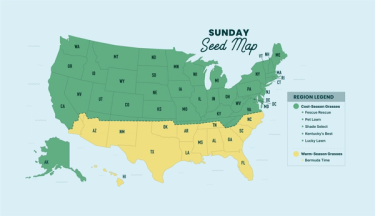
Cool-season grass zones
Cool-season grasses (tall fescue, Kentucky bluegrass, and perennial ryegrass) germinate best when soil temperatures are between 50°F and 65°F and daytime air temperatures hover between 60°F and 75°F. Fall is better than spring for these grasses. Seedlings face less competition because most annual weeds are winding down, and roots get a full fall-plus-spring growing period before summer heat returns.
A good rule of thumb: seed at least 45 days before your region's average first frost. That gives seedlings enough time to settle in before the ground freezes. For the rest of your autumn to-do list, see our cool-season fall lawn care playbook.
Warm-season grass zones
Warm-season grasses like bermuda, zoysia, and St. Augustine germinate when soil temperatures are 65°F to 70°F and rising, which makes late spring through early summer their prime seeding window, not fall. If you're in the Deep South or Gulf Coast, fall overseeding with a warm-season grass generally isn't recommended. Some southern homeowners overseed bermuda lawns with perennial ryegrass in fall for winter color, but that's a temporary cosmetic choice, not a permanent repair. Our warm-season fall lawn care prep guide covers what southern lawns need right now.
How to check soil temperature
No guessing required. A simple soil thermometer inserted 2 to 3 inches deep in the morning gives you an accurate reading. Take measurements for a few consecutive days to confirm your soil is holding in the right range.
The full overseeding process, step by step
Overseeding isn't just tossing seed on your lawn and hoping for the best. Each step below improves seed-to-soil contact, the most important factor in germination success. (For more depth on the whole routine, see how to overseed your lawn.)
Mow Low
Before anything else, mow your existing lawn down to about 1.5 to 2 inches, shorter than your normal mowing height. Bag the clippings so they don't smother new seed. This lets sunlight reach the soil surface and reduces competition from established grass blades.
Dethatch
Thatch is the layer of dead stems and roots that builds up between the soil surface and the green grass blades. A thin layer (under 1/2 inch) is fine, but anything thicker acts as a barrier that keeps seed from reaching soil. Use a dethatching rake for small areas or a power dethatcher for larger lawns. Remove the debris when you're done.
Core Aerate
Core aeration pulls small plugs of soil out of the ground, typically 2 to 3 inches deep and about 3/4 inch in diameter, spaced roughly 3 to 4 inches apart. This relieves soil compaction, improves water and air movement to the root zone, and creates little pockets for seed to settle into. Leave the plugs on the surface; they'll break down naturally within a week or two. For most home lawns, a single pass with a core aerator is enough. Rent one from a local equipment rental shop or hire a lawn care company for this step.
Spread Seed
Use a broadcast spreader for even coverage. General overseeding rates vary by grass type:
- Tall fescue: 6 to 8 pounds per 1,000 square feet
- Kentucky bluegrass: 2 to 3 pounds per 1,000 square feet
- Perennial ryegrass: 4 to 6 pounds per 1,000 square feet
For the most uniform distribution, split your seed into two halves and make two passes, one in each direction, north-south then east-west. This prevents striping and thin spots. Sunday's grass seed how-to walks through spreader settings and application in more detail. All spreaders are different, even if there are settings on the packaging, we still highly recommend to calibrate your spreader.
Topdress
After spreading seed, apply a thin layer of compost or topsoil, about 1/8 inch, over the seeded area. This improves moisture retention around the seed, protects it from birds, and boosts seed-to-soil contact. You don't need much: roughly 1 cubic yard of compost covers about 1,000 square feet at 1/4-inch depth.
Water Consistently
Watering is where most overseeding projects succeed or fail. Here's the schedule:
- Days 1–14: Water lightly 2 to 3 times per day, keeping the top 1/2 inch of soil consistently moist. Each session should run about 5 to 10 minutes per zone, just enough to dampen the surface without creating puddles or runoff.
- Days 15–21: Reduce to once daily, watering slightly longer, 10 to 15 minutes, to encourage roots to grow deeper.
- Days 22–30: Transition to every other day, applying about 1/2 inch of water per session. By now, seedlings should be well-rooted enough to handle less frequent irrigation.
The goal is to never let the seed dry out during the first two weeks. A dry seed is a dead seed. (More pitfalls to dodge in our guide to common watering mistakes.)
Bare spot repair: the patch-and-seed technique
Bare spots need a slightly different approach than general overseeding. The patch is smaller, so precision matters more. For the full walkthrough, see patching bare spots in your lawn.
Why seed fails on top of thatch
Sprinkle seed onto a bare spot without prepping the surface, and most of it will sit on top of dead grass, thatch, or compacted soil. Seeds need direct contact with loose soil to absorb moisture and send roots downward. Seed sitting on thatch dries out quickly and often washes away with the first rain.
Preparing the soil
Start by raking out any dead grass, debris, or loose thatch from the bare area. If the soil underneath is hard and compacted, loosen the top inch with a garden rake or hand cultivator. For spots where the soil level has sunk below the surrounding lawn, add enough topsoil or compost to bring it level with the adjacent grade.
Getting real seed-to-soil contact
Spread seed at a slightly higher rate than you'd use for general overseeding, about 50% more, since bare spots have no existing grass to fill in gaps. Press the seed into the soil using the flat back of a rake or by lightly tamping with your foot. Then cover with a thin layer (1/8 to 1/4 inch) of compost. For spots larger than a few square feet, consider a light layer of straw mulch to hold moisture and prevent erosion(not hay). Keep the area consistently moist following the same watering schedule outlined above.
An alternative is Sunday's Bare Repair products, which combine seed, mulch, and nutrients in one bag so the prep-press-cover routine is mostly done for you.
Choosing the right grass seed for your lawn
Picking the right seed matters as much as technique. The best choice depends on your climate zone, how much sun the area gets, and how much foot traffic it handles. Not sure which camp you're in? Start with our guide to cool-season vs. warm-season grasses, or let Sunday's Seed Finder match a seed to your yard.
Your 30-day post-seeding calendar
Once the seed is down, the next 30 days determine everything. Here's the month at a glance:
Week 1 (days 1–7): keep it moist
Water 2 to 3 times daily for 5 to 10 minutes per zone. The soil surface should never dry out completely. Expect germination by day 5 to 7 for ryegrass, or day 7 to 10 for fescue. Kentucky bluegrass is slower, sometimes taking 14 to 21 days.
Do not mow. Do not walk on seeded areas.
Week 2 (days 8–14): early germination
Continue the same light, frequent watering schedule. Most cool-season seed will have visibly germinated by the end of this week. If you applied a Sunday fertilizer shipment before seeding, the nutrients are already feeding those new roots. If your fall Sunday shipment hasn't arrived yet, hold off. You'll apply it in week 3 or 4.
Week 3 (days 15–21): transition watering
Reduce watering to once daily, extending each session to 10 to 15 minutes. This encourages roots to chase moisture deeper into the soil rather than staying at the surface. New grass should be about 1 to 2 inches tall by now.
This is a good time to apply your Sunday seasonal fertilizer if you haven't already. Sunday's fall shipments are pesticide-free and designed to support root development. The nutrients in your plan are tailored to your soil's needs based on your soil test results, so you're feeding what's actually missing rather than guessing.
Week 4 (days 22–30): first mow and deeper roots
Transition to watering every other day, applying roughly 1/2 inch per session. When new grass reaches 3 to 3.5 inches, it's time for the first mow. Set your mower to 3 inches and make sure the blade is sharp. A dull blade tears young grass instead of cutting it cleanly, which stresses the plant and invites disease. See our mowing height chart for every grass type.
After the first mow, your new grass is established enough to blend into your regular routine. Keep following your Sunday plan through the rest of fall to build the root system that will carry your lawn through winter and into spring.
Frequently Asked Questions
When is the best time to overseed my lawn?
For cool-season grasses, the best time is late August through mid-October, depending on your region. You want soil temperatures between 50°F and 65°F and at least 45 days before the first expected frost. Warm-season grasses should be seeded in late spring or early summer when soil temperatures are 65°F to 70°F and rising.
How much grass seed do I need per square foot?
It depends on the grass type and whether you're overseeding an existing lawn or repairing bare spots. For general overseeding, tall fescue needs about 6 to 8 pounds per 1,000 square feet. Kentucky bluegrass needs 2 to 3 pounds per 1,000 square feet, and perennial ryegrass needs 4 to 6 pounds. For bare spot repair, increase these rates by about 50% to ensure full coverage.
How long after overseeding before I can mow?
Wait until new grass reaches 3 to 3.5 inches tall before mowing for the first time, typically around 3 to 4 weeks after seeding. Set your mower height to 3 inches so you're removing no more than one-third of the blade length. Use a sharp mower blade, and avoid turning sharply on new grass to prevent pulling up young seedlings that haven't fully rooted yet.
How can I check whether the soil is warm enough for overseeding?
Insert a soil thermometer 2 to 3 inches into the ground in the morning and record the temperature for several consecutive days. Cool-season grasses germinate best when soil stays between 50°F and 65°F. Warm-season grasses need soil temperatures from 65°F to 70°F and rising.
How should I water after overseeding?
During days 1 through 14, water lightly 2 to 3 times daily for 5 to 10 minutes per zone, keeping the top 1/2 inch of soil moist. During days 15 through 21, water once daily for 10 to 15 minutes. During days 22 through 30, water every other day and apply about 1/2 inch per session.
How do I repair bare spots in a lawn?
Rake away dead grass, debris, and loose thatch, then loosen the top 1 to 2 inches of compacted soil. Add topsoil or compost if the area sits below the surrounding lawn. Apply about 50% more seed than the general overseeding rate, press it into the soil, cover it with 1/8 to 1/4 inch of compost, and keep it consistently moist.