


What Makes a Lawn Fertilizer "Health-Boosting"?
A health-boosting lawn fertilizer improves the biological vitality of your soil and grass over time, rather than just providing a temporary green up. The distinction matters because many conventional fertilizers deliver fast visual results but may negatively affect soil health in the long run.
True lawn health means your grass has deep, robust root systems, resists disease and drought stress naturally, and maintains consistent color and density throughout the growing season. This definition of health goes beyond appearance - it encompasses the entire ecosystem both above and below the soil surface. Understanding why lawn soil health matters is the first step toward choosing fertilizers that deliver lasting results.
Health-boosting fertilizers share several key characteristics. They provide nutrients in forms that soil microbes can process efficiently, avoid excessive salt buildup that damages soil structure over time, and deliver nutrients at rates your grass can actually absorb rather than overwhelming the system with more than it needs.
The NPK ratio on a fertilizer bag tells you the percentage of nitrogen (N), phosphorus (P), and potassium (K) by weight. Nitrogen drives leaf growth and green color. Phosphorus supports root development and energy transfer. Potassium strengthens cell walls and improves stress tolerance. A health-boosting fertilizer balances these nutrients based on what your soil lacks, not on a one-size-fits-all formula.
How to Choose a Fertilizer Based on Your Soil Test Results
The most important step in correctly choosing your lawn fertilizers is a soil test - without one, you're essentially guessing at what your lawn needs. Soil testing reveals your current nutrient levels, pH balance, and organic matter content, giving you the data needed to make informed fertilizer decisions.
Sunday offers standalone soil tests for anyone interested in a quick read on their soil, and each of our Custom Lawn Plans automatically includes a soil test in the first box. Included in the test will be the concentration of macronutrients like phosphorus and potassium, micronutrients like calcium and magnesium along with other soil properties (e.g. organic matter content, pH, and cation exchange capacity/CEC).
When your soil test comes back, first examine your macronutrient concentrations. Nitrogen is needed in the greatest concentration by grass and there isn't a reliable way to accurately test the available nitrogen, so you'll see the majority of fertilizers have a high % of nitrogen. Similarly, just about all lawns will benefit from small amounts of potassium throughout the season, so you'll see most fertilizers also contain some potassium. The last macronutrient, phosphorus, is often not included in fertilizers. Why? Most lawns have enough available phosphorus already, and providing nutrients the grass can access on it's own not only wastes your money, it can also have a negative impact by compromising the root system, contributing to environmental runoff, and increasing the risk of disease issues. Outside of Lawn Starter, a specialized pouch for phosphorous deficient soils, none of Sunday's fertilizers contain phosphorous as a result.
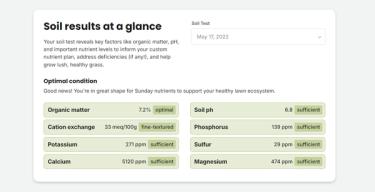
The next thing to check is pH. Most lawn grasses prefer a slightly acidic to just below neutral soil (pH 5.9-6.9). But grass species are very adaptive to a wide range of pH and can still grow outside of this range. Very acidic soils can benefit from lime applications to raise pH while very alkaline soils may benefit from sulfur amendments to lower the pH. Chasing the perfect pH can be expensive and it may take several years to see a measurable shift. Before trying to shift your pH, make sure you've addressed any other obstacles that may be impacting the health of the lawn, and the grass may be able to work around the pH.
Finally, consider the time of year and your grass' active growth period. For example, a fertilizer containing a high amount of nitrogen may not be the best choice for a fescue lawn in the peak part of summer.
Overwhelmed? Our Custom Lawn Plans help you take the guesswork out of which fertilizer to apply, automatically sending as needed based on your soil test results, eco-region, and your grass type.
Organic vs. Synthetic Fertilizers: Which Is Better for Lawn Health?
Organic fertilizers generally support better long-term soil health because they feed soil microorganisms that create sustainable nutrient cycling, while synthetic fertilizers deliver faster visible results but can degrade soil biology over time.
Organic fertilizers come from natural sources like composted manure, bone meal, soy protein, seaweed, and molasses. They release nutrients slowly as soil microbes break down the organic matter. This gradual release matches how grass naturally absorbs nutrients, reducing the risk of fertilizer burn and nutrient runoff.
The benefits of organic options extend beyond nutrition. They help improve soil structure by adding organic matter, can increase water retention in sandy soils, improve drainage in clay soils, and support beneficial microbial populations. Understanding why root depth matters reveals how these soil improvements translate to healthier, more drought-resistant grass over time.
Synthetic fertilizers are manufactured chemical compounds that deliver nutrients in immediately plant-available forms. They work faster and cost less per unit of nutrient than organic alternatives. However, synthetic fertilizers don't contribute to soil organic matter and can harm beneficial soil organisms when overused. High-salt synthetic formulas may damage soil structure over time, creating conditions where grass becomes increasingly dependent on fertilizer inputs to survive.
Safety Considerations for Kids, Pets, and the Environment
Lawn fertilizers can be safe for kids, pets, and the environment when you choose appropriate products and follow proper application guidelines - the key is understanding which ingredients pose risks and which don't.
The primary safety concerns with lawn fertilizers involve three categories: chemical burns from direct contact with concentrated products, ingestion risks for children and pets, and environmental contamination through runoff into waterways.
For households with children and pets, products derived from plant materials, composted manure, or mineral sources like sulfate of potash present lower immediate toxicity risks and are typically safe once watered into the lawn. However, some organic ingredients like blood meal and bone meal can attract dogs, so keep pets off treated areas until the product is watered in and dried.
Environmental safety extends beyond your property line. Fertilizer runoff contributes to algal blooms and water quality degradation in lakes, rivers, and coastal areas. Responsible application means never fertilizing before heavy rain, keeping products off hardscapes where they wash into storm drains, and applying only what your soil test indicates you need.
Get a Custom Lawn Nutrition Plan with Sunday
The most effective approach to lawn fertilization starts with understanding your specific soil conditions and receiving customized product recommendations based on actual data. Generic fertilizer advice can only take you so far - your lawn's needs may differ from your neighbor's based on soil composition, grass type, or sun exposure.
Sunday's commitment to safer, more sustainable lawn care is documented in the 2025 Impact Report, which details the environmental and safety standards behind their product formulations. For homeowners who want effective results without compromising on safety for their families or the environment, this data-driven approach offers a clear path forward.
The shift from guessing at fertilizer needs to making decisions based on soil data represents the biggest opportunity most homeowners have to improve their lawn health while reducing waste and environmental impact. When you know exactly what your soil lacks, you can provide exactly what it needs - nothing more, nothing less.
Frequently Asked Questions
What does "lawn health" actually mean, and why does it matter?
Lawn health refers to the overall biological vitality of your grass and soil ecosystem, encompassing root depth, disease resistance, nutrient cycling, and the ability to withstand environmental stressors like drought and foot traffic. A healthy lawn requires less water, fewer chemical inputs, and recovers faster from damage than an unhealthy one. This matters because investing in true lawn health reduces long-term maintenance costs while creating a safer, more resilient outdoor space for your family.
What are the best fertilizers for improving grass health in 2026?
The best fertilizers for improving grass health in 2026 are slow-release organic or bio-based products matched to your soil's specific nutrient deficiencies as revealed by a soil test.
Are organic lawn fertilizers as effective as synthetic ones for grass health?
Organic lawn fertilizers are equally effective as synthetic options for long-term grass health, though they work more slowly and may cost more per application. Organic products feed soil microorganisms that create sustainable nutrient cycling, improve soil structure, and build conditions where grass thrives with less intervention over time. Synthetic fertilizers deliver faster visible results but don't contribute to soil biology and can degrade soil health when overused.
What are the key nutrients a lawn needs to stay healthy?
The three primary nutrients lawns need are nitrogen (N) for leaf growth and green color, phosphorus (P) for root development and energy transfer, and potassium (K) for cell wall strength and stress tolerance. Secondary nutrients including calcium, magnesium, and sulfur also play important roles, as do micronutrients like iron and manganese. A soil test reveals which nutrients your specific lawn lacks so you can choose fertilizers that address actual deficiencies rather than applying everything indiscriminately.
How often should you fertilize your lawn for optimal health?
Most lawns benefit from 2-4 fertilizer applications per year, but this can vary based on your soil and grass type's active growth periods. Over-fertilizing causes more problems than under-fertilizing, so follow soil test recommendations rather than applying on a fixed schedule.
Which lawn fertilizers are safe for kids, pets, and public green spaces?
Organic fertilizers derived from plant materials, composted manure, or mineral sources are generally safest for kids, pets, and public spaces once watered into the lawn and dried. Even with safer products, keep children and pets off treated areas until the fertilizer has been watered in and the grass is dry. Avoid quick-release synthetic fertilizers with high salt content in areas with heavy foot traffic from children or pets.
What are the signs of an unhealthy lawn and how can fertilizer help?
Signs of an unhealthy lawn include yellowing or pale green color, thin or patchy growth, shallow root systems, increased weed pressure, and poor recovery from foot traffic or drought stress. Fertilizer helps by providing nutrients the grass needs to build stronger cell walls, deeper roots, and denser growth that crowds out weeds. However, fertilizer alone won't fix problems caused by compacted soil, improper watering, or pest damage - diagnosis of the underlying issue is essential before assuming more nutrients will solve the problem. Ask Sunny or one of our expert Yard Advisors to learn more!